
Gorgeous Plants & Ideas from Markshall Garden
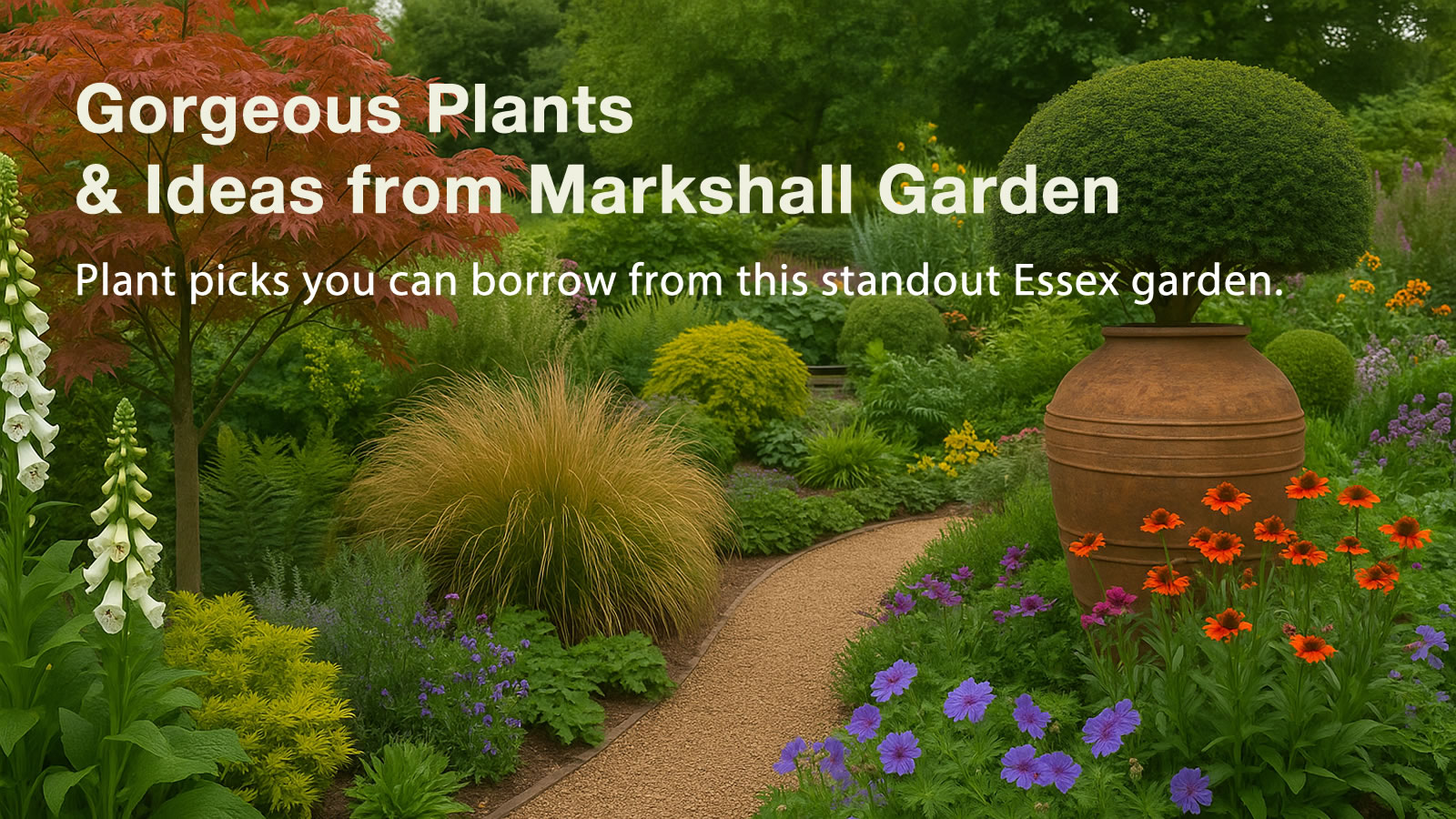
An introduction to Markshall’s Walled Garden
Within the Markshall Estate in Essex, the Walled Garden blends formal geometry with exuberant seasonal planting. It’s celebrated for its long, richly layered borders and a sequence of interlinked spaces that guide you through spring freshness, summer abundance and autumn warmth. For home gardeners, it’s a masterclass in how structure and repetition can make colour feel composed rather than chaotic.
A brief history & design intent
Like many historic estates, the original purpose of the walled garden was productive — fruit, vegetables and cut flowers. In recent decades it’s evolved into a decorative showcase while retaining its bones: brick walls, axial paths and clipped structure. That framework lets the gardeners dial up seasonal drama without losing clarity.
Key zones & planting themes
The Walled Garden reads as a series of “rooms,” each with a distinct mood:
- Spring court: fresh whites and blues with bulbs and blossom — think narcissus, species tulips, brunnera and Amelanchier.
- Linear walk: a calm axis under small trees; restrained palettes and repeating perennials keep the eye moving.
- Summer heat garden: warm reds, oranges and golds with Hylotelephium (sedum), rudbeckias, crocosmia and ornamental grasses.
- Quiet corners: clipped evergreens, simple water and seating; proof that contrast and rest make colour sing louder elsewhere.
The long double herbaceous border
This is the garden’s spine. A mirrored or near-mirrored double border runs the length of a central path, mixing perennials, grasses and seasonal bulbs. The lesson for smaller plots: you don’t need the length — you need the logic. Repeat anchor plants every 1.5–2 m, use drifts of 3–5 plants, and let a few tall see-throughs (Verbena bonariensis, sanguisorbas) link foreground and background.
- Spring: alliums through early perennials for lift.
- Summer: salvias, echinaceas, achilleas; grasses building volume.
- Autumn: asters, anemones, hylotelephium; seedheads left for structure.
Seasonal planting ideas to borrow
Spring to early summer
Layer bulbs at the front and weave blues (brunnera, nepeta) with fresh greens. Use small tree canopies to filter light and create intimacy.
High summer
Dial up saturation: Salvia ‘Caradonna’, Rudbeckia ‘Goldsturm’, Crocosmia, Echinacea, and upright grasses like Calamagrostis for strong verticals.
Late season
Warm the palette with asters, anemones and tawny grasses. Leave seedheads on echinacea and allium for winter silhouette and wildlife.
Design takeaways for small UK gardens
- Create a spine: a simple central path or axis with double planting beds instantly reads “garden.”
- Repeat anchors: choose 3–4 anchor plants and repeat them rhythmically; fill between with seasonal colour.
- Mix structure with softness: clipped shapes (yew, ilex, pittosporum) make summer perennials feel intentional.
- Think in rooms: low hedging or trellis implies transitions without blocking views.
Visiting tips & best times
For the biggest border impact, go from late spring through midsummer; autumn brings rich tones and textured seedheads. Early morning or overcast days are best for photography. Check the Markshall Estate website for opening times and seasonal highlights.
FAQs
Is it “Marks Hall” or “Markshall”?
The correct name is Markshall Estate and Walled Garden. We retain “marks-hall” in the page URL for historical/backlink reasons.
Can I recreate the double border at home?
Yes — scale it down. Two 80–100 cm beds flanking a 90 cm path, repeating anchor plants every 1.5–2 m, works in small gardens.
What’s a good beginner palette?
Salvia ‘Caradonna’, Achillea ‘Terracotta’, Geranium ‘Rozanne’, Calamagrostis ‘Karl Foerster’, with bulbs (alliums/tulips) and an evergreen backbone.
Further reading & sources
Related guides on Growing Nicely
- Spring-Flowering Bulbs to Look Forward To
- How to Grow Hardy Annual Flowers from Seed
- The Best Flowering Climbers for Fences
Trusted references
Love the Markshall look? Build structure and seasonal colour with reliable perennials —
browse plant collections at Crocus.
Some links are sponsored; this doesn’t affect our recommendations.